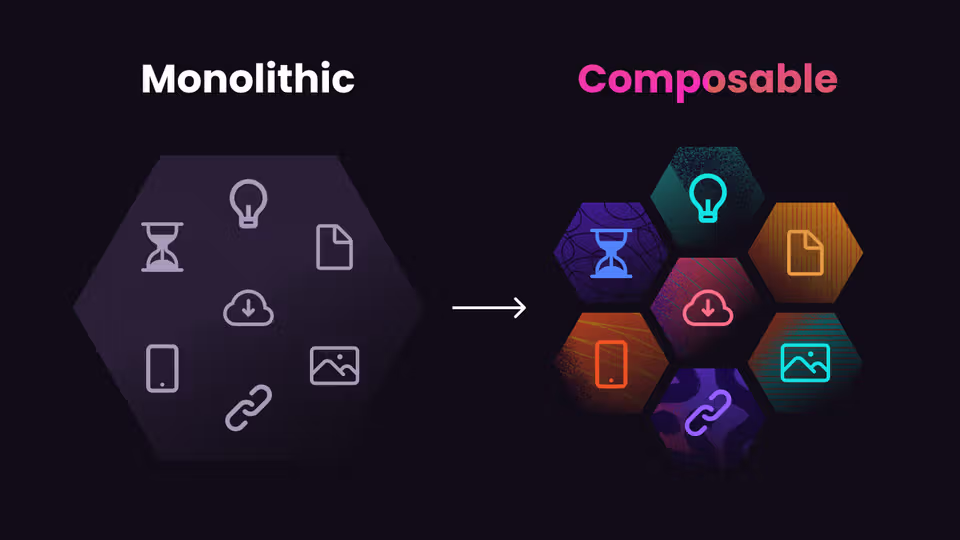

In today’s fast-paced digital world, agility and scalability are everything. Traditional monolithic software development, with tightly-coupled components and inflexible structures, often slows down innovation. Enter Composable Software Architecture — a game-changing approach that’s transforming how apps are built, deployed, and scaled. Think of it as building software like a Lego set, where each piece is purposeful, reusable, and swappable.
Whether you’re a developer, architect, or tech-savvy business leader, understanding this architectural shift is essential to staying competitive and future-ready.
What is Composable Software Architecture?
Composable Software Architecture is a modular development approach that assembles software applications using independent, interchangeable components. These components are often packaged as services (like microservices) or APIs, allowing teams to build apps by combining smaller parts rather than coding everything from scratch.
Each “block” in a composable system performs a specific function — whether it’s user authentication, payment processing, or content management — and can be plugged into or removed from an application as needed.
Why It’s Like Lego for Developers
Just like Lego bricks:

- Each piece has a standard interface.
- You can combine them in many ways.
- You can remove or replace one without taking apart the whole thing.
- They are reusable and scalable.
This flexibility empowers developers to build complex systems faster, troubleshoot more efficiently, and pivot with market needs without overhauling the entire codebase.
Key Principles of Composable Architecture
1. Modularity
The foundation of composable architecture is breaking software into distinct modules. Each module represents a core function or feature and can work independently or alongside others.
2. API-First Approach
APIs (Application Programming Interfaces) allow components to communicate in a predictable way. This “plug-and-play” integration is what makes services composable.
3. Cloud-Native & Headless
Most composable architectures are designed for the cloud and follow headless architecture, meaning the backend and frontend are decoupled. This makes it easier to deliver content or services to any device or platform.
4. Reusability
Once a module is created — like a login system or inventory service — it can be reused across multiple apps, reducing development time and increasing consistency.
Real-World Use Cases
E-commerce
Many modern e-commerce platforms like Shopify Hydrogen or CommerceTools use composable architecture. A business can swap payment gateways, add new fulfillment partners, or integrate loyalty programs without disrupting core services.
Media & Content Platforms
Headless CMS tools like Contentful and Strapi exemplify composable systems, letting teams deliver the same content to websites, apps, voice assistants, and smart TVs — all from a single backend.
Enterprise Software
Composable ERP platforms allow enterprises to pick only the services they need — HR, CRM, inventory — and integrate them into a custom workflow that evolves with their business.
Benefits of Going Composable

- Faster Time to Market: Teams can build and launch new features without waiting on entire system updates.
- Lower Maintenance Costs: Bugs or upgrades in one module don’t affect others.
- Improved User Experience: Apps run smoother with better performance and personalized, scalable services.
- Future-Proofing: Easily adopt new technologies or services by swapping out outdated components.
Challenges and Considerations
- Complex Initial Setup: Designing a composable system takes more upfront planning.
- Integration Overhead: Ensuring all APIs and modules talk to each other properly can be tricky.
- Governance & Security: Managing dozens of independent services requires strong API management and security protocols.
- Vendor Lock-In Risks: If third-party services are used extensively, switching providers may become difficult.
That said, modern tools and platforms like Kubernetes, GraphQL, Docker, and service meshes are making these challenges easier to manage.
How to Get Started with Composable Architecture
- Audit Your Current Stack: Identify monolithic systems that slow you down.
- Define Modular Boundaries: Break down the application into core capabilities or services.
- Choose Composable Tools: Use headless CMS, MACH-compliant platforms (Microservices, API-first, Cloud-native, Headless), and modern CI/CD pipelines.
- Start Small: Don’t try to rebuild everything overnight. Replace one module at a time.
- Use a Design System: For frontend composability, a consistent design system ensures UI components are reusable across pages or apps.
The Future Is Composable
With technology moving at lightning speed, the ability to adapt quickly is a competitive edge. Composable software architecture gives organizations the agility, scalability, and resilience they need to stay ahead — much like building Lego structures that can be endlessly modified.
In an era where change is the only constant, the smartest approach might just be the most modular one.