
If you drive down Chile’s famous Carretera Austral—a long, dusty highway that cuts through some of the wildest parts of Patagonia—you’ll eventually hit a tiny, sleepy village called Puerto Río Tranquilo. There isn’t much going on in town, but right off the shore sits Lake General Carrera, home to one of the stranger natural landscapes on the planet.
Local guides call them the Cuevas de Mármol, or the Marble Caves.
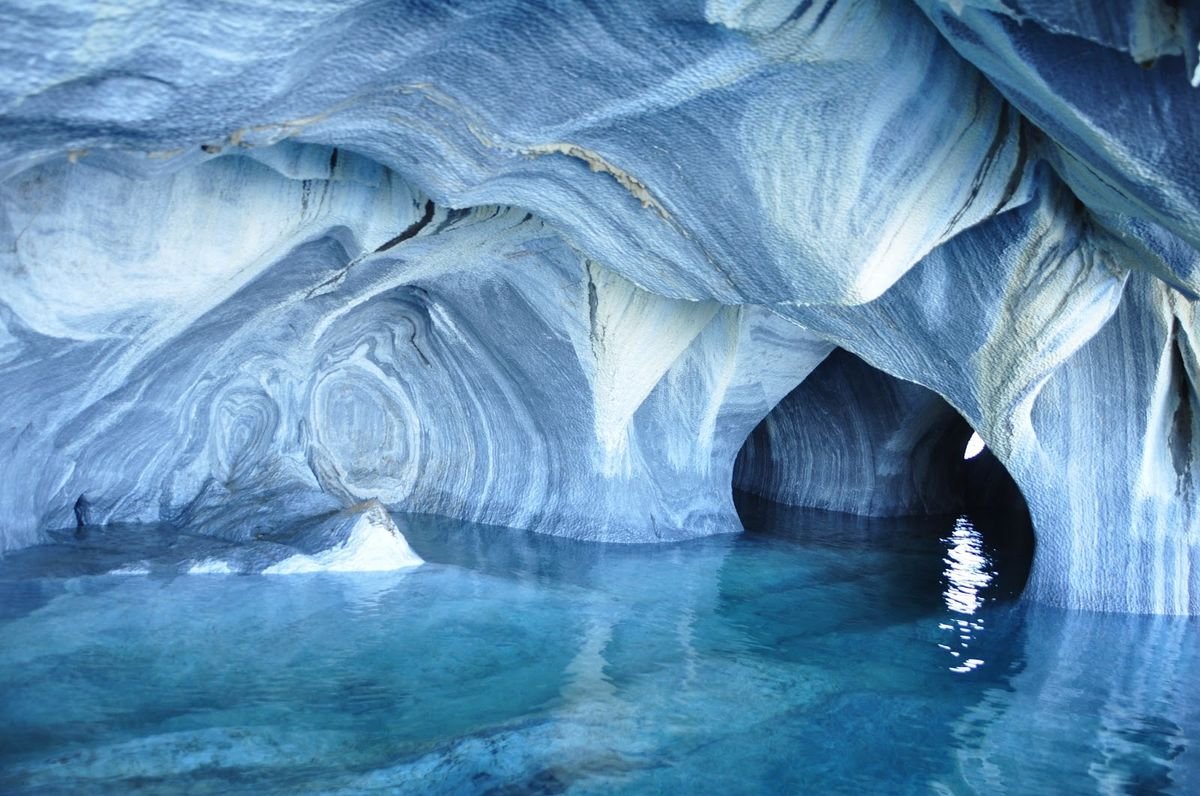
They’re a massive network of smooth, hollowed-out caverns made entirely of solid marble, rising straight up out of bright blue glacial water. From a distance, they just look like gray rocks sitting in the bay. But once you get a boat inside them, the whole place feels like a giant, hand-carved cathedral.
How Water Carved Out Solid Marble
The story of how these caves formed comes down to thousands of years of patience.
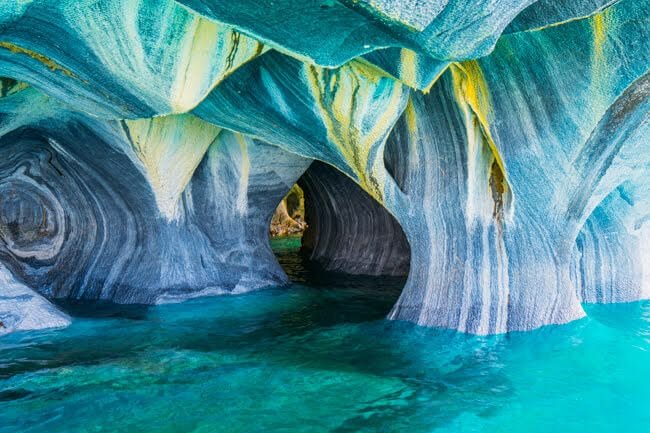
When the last glaciers started melting in Patagonia thousands of years ago, they filled up this massive basin and formed the lake. Glacial water carries tiny bits of ground-up rock mineral—what geologists call “rock flour”—and when sunlight hits those floating particles, it bounces back an almost neon turquoise color.
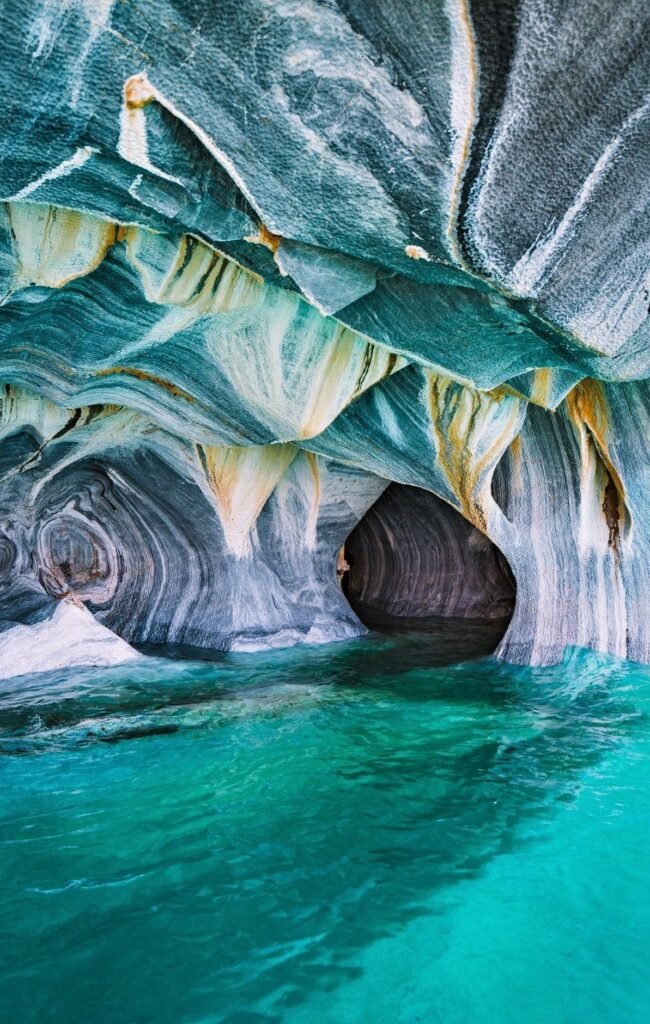
Over thousands of years, the lake’s choppy waves kept crashing against the solid marble cliffs along the shore. Bit by bit, the water dissolved the softer rock, carving out deep hollow chambers and smoothing the remaining stone into swirling patterns of white, gray, and yellow.
The three main formations—the Marble Chapel, the Marble Cathedral, and the main Marble Cave—literally look like someone sculpted them by hand.
The Light Changes Depending on When You Go
One of the coolest things about the caves is that they never look the same twice.
If you visit in early spring, the water level is fairly low because the mountain glaciers haven’t completely melted yet. The shallow water lets the sun bounce off the lakebed, casting a light, pale turquoise glow all over the cave ceilings. You can also see lower stone arches that get completely submerged later in the season.
By late summer, all that melting ice fills the lake up to its peak. The water turns a much deeper cobalt blue, rising almost to the roof of the caves and creating a really sharp contrast against the pale marble walls.
Even throughout a single afternoon, as the sun moves across the sky, the colors on the walls shift from soft gray to glowing blue.
Getting There Isn’t Easy (Which Is the Point)
The main reason the Marble Caves aren’t overrun with tour buses and massive crowds is pretty simple: they’re annoying to get to.
First, you have to fly into Coyhaique in southern Chile, rent a car, and drive four or five hours south on rough, unpaved dirt roads. Once you finally make it to Puerto Río Tranquilo, you have two ways to actually see the caves:
- Local Motorboats: Local boat captains take small groups out on short 30-minute runs. They know the water well enough to dodge low overhangs and coast right into the bigger chambers so you can reach out and touch the stone.
- Kayaking: If the lake is calm, you can hire a guide and paddle out yourself. Kayaking takes a bit more effort, but slipping through the narrow marble tunnels at your own pace without an engine running is easily the best way to do it.
Patagonia’s weather is notoriously unpredictable, and strong winds can shut down boat trips for hours without warning. But if you’re patient enough to make the trip down, sitting in a small boat under a roof of carved blue marble is something you won’t ever forget.