
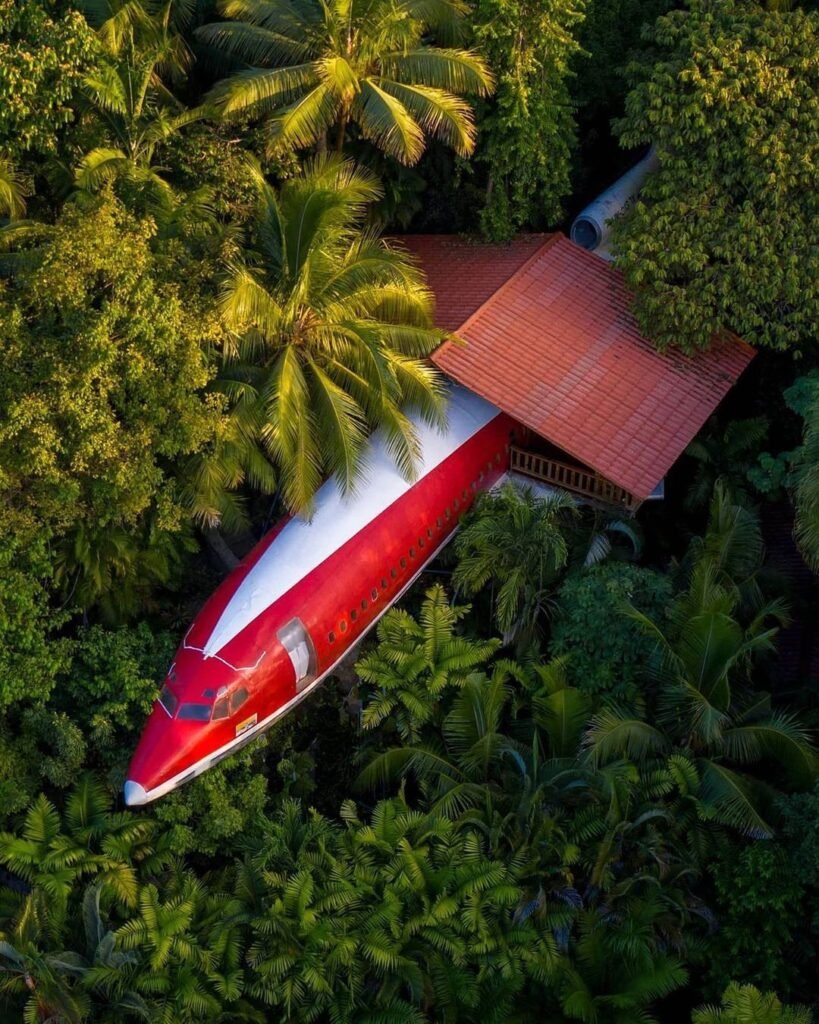
Tucked deep into the lush canopy of the Costa Rican jungle, hovering fifty feet above the forest floor, sits a fully restored 1965 Boeing 727. From the outside, it looks like an emergency landing went unexpectedly right. But step inside, and you aren’t met with cramped economy seats or tiny overhead bins.
Instead, you find hand-carved teak paneling, air-conditioned ocean-view bedrooms, and a private wooden deck built directly onto the right wing, where sloths and toucans frequently swing by for breakfast.
Welcome to the world of aircraft hospitality—where retired commercial airplanes are salvaged from boneyards, hauled through dense terrain, and transformed into some of the most extraordinary eco-luxury suites on the planet.
From the Scrapyard to the Canopy
Commercial aircraft have a strict lifespan. Once a jet reaches a certain number of flight hours or becomes too expensive to maintain, it is typically decommissioned and sent to a desert “boneyard” to be stripped for parts or melted down for scrap metal.
Transforming a massive multi-ton fuselage into a luxury suite is an engineering nightmare, but it is also the ultimate form of upcycling.
Take the famous 727 suite at Hotel Costa Verde near Manuel Antonio National Park. The plane original flew for South Africa Airways and Avianca. After sitting abandoned at a San Jose airport, the fuselage was painstakingly disassembled, transported piece by piece on five semi-trailers through winding mountain roads, and reassembled on custom-built pillar pedestals in the jungle.
Positioned at canopy height, the plane was oriented specifically to catch the offshore breeze and offer unobstructed views of the Pacific Ocean.
What It’s Actually Like to Stay Inside
Sleeping in a converted plane completely flips the traditional hotel experience on its head.
- The Interior: The aluminum skin of the fuselage is insulated and fully lined with locally sourced teak wood, creating a warm, cabin-like atmosphere that feels more like a luxury yacht than a commercial jet.
- The Layout: A typical Boeing 727 setup houses two spacious, air-conditioned bedrooms with private en-suite bathrooms, a kitchenette, and a central dining area where the main cabin used to be.
- The Cockpit: The original flight deck is often preserved, allowing guests to sit in the pilot’s seat with a drink in hand, looking out over the treetops through the original windshield windows.
- The Wing Deck: The absolute highlight for most guests is the exterior deck attached to the top of the wing. It offers a front-row seat to the rainforest’s upper canopy, putting you eye-to-eye with capuchin monkeys, howler monkeys, and tropical birds.
Why “Plane Hotels” Are Capturing the Global Imagination
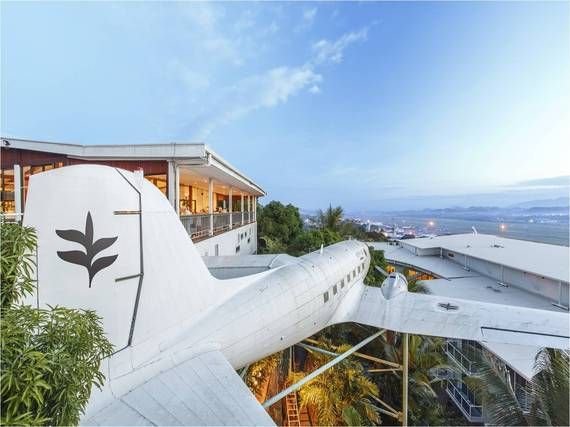
The rise of converted aircraft suites taps into two major shifts in modern travel: the demand for unique, experiential stays and the push for creative eco-architecture.
- Unmatched Upcycling: Instead of letting tons of high-grade aluminum rust in a landfill or require energy-intensive smelting, adaptive reuse gives the airframe a second life that can last for decades.
- Minimal Footprint: Because the fuselage is suspended on pedestals or integrated into existing slopes, building a plane suite often requires far less ground disturbance than constructing a traditional multi-story concrete hotel building.
- Pure Novelty: In an era where many luxury hotels are starting to look identical, sleeping inside an iconic piece of aviation history offers a story you simply can’t get anywhere else.
The Takeaway
Plane hotels prove that with enough imagination, even a decommissioned piece of industrial machinery can become a seamless part of the natural landscape. Floating above the jungle, these elevated suites offer travelers a rare blend of aviation history, sustainable design, and front-row seats to the wild heart of the rainforest.