
Everyone knows the Italy they have seen on a mood board. The canals of Venice, glassy and tourist-dense. The Uffizi queue in Florence, three hours in August sun. The Amalfi Coast road, spectacular and gridlocked, with coaches and scooters negotiating the same hairpin curves simultaneously. These places are extraordinary. They are also, by any honest measure, finished as places of discovery — their beauty intact, their surprise long since replaced by infrastructure built to receive you at volume.
But Italy is a long country. It extends 1,185 kilometres from the Alps to the heel of its boot. And the further south you drive — past Naples, past Salerno, past the point where the tourist map begins to thin and eventually stops being updated — the more the country becomes something else. Something slower, stranger, more demanding of attention and more generously rewarding of it.
This is the Mezzogiorno. The land of the midday sun. And it is, mile for mile, the greatest undiscovered road trip in Europe.
What the Mezzogiorno Actually Is
The Mezzogiorno — the collective term for Italy’s south, encompassing the regions of Campania, Basilicata, Calabria, Puglia, and Sicily — has been the subject of a particular Italian ambivalence for over a century. Wealthier, more industrialised northern Italy has regarded it with a mixture of paternalism and neglect. The south, in turn, has developed a culture of extraordinary self-sufficiency, local pride, and culinary and architectural identity so distinct from the north that travelling between them feels, at times, like moving between different countries sharing a language.
The result for travellers is an Italy that has not been standardised. Where the north’s most famous towns have developed a tourist grammar — the acceptable restaurant, the appropriate gelato shop, the curated experience priced for international visitors — the south’s villages operate on their own logic. The restaurant is the one the grandmother opened forty years ago and never needed to advertise because everyone already knows it is there. The accommodation is the palazzo that a local family converted because the building was too beautiful to leave empty. The experience is the one that happens because you stopped and someone decided you were interesting enough to talk to.
The Road South: Five Places Worth Stopping
Matera, Basilicata
Already encountered in this series, but impossible to omit from any southern Italian itinerary: the cave city carved into a ravine, inhabited for 9,000 years, once declared a national disgrace and now a UNESCO World Heritage Site of startling beauty. Matera is the entry point to the Mezzogiorno — the first signal that what follows will be unlike anything further north.
Alberobello, Puglia
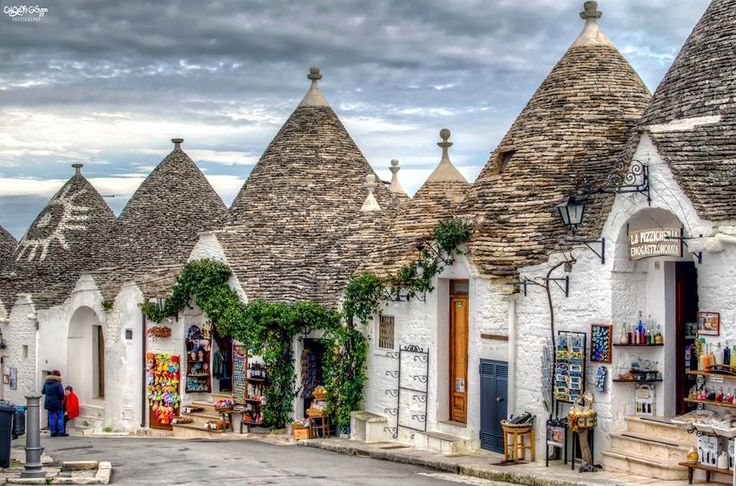
The trulli — conical stone houses built without mortar, whitewashed, topped with grey limestone pinnacles — are one of the most architecturally distinctive settlements in Europe. Alberobello’s UNESCO-protected Rione Monti district contains over 1,500 of them, many still inhabited, some converted into accommodation where you sleep inside a building technique that has existed unchanged since the 14th century. The surrounding Valle d’Itria — olive groves, dry stone walls, masserie (fortified farmhouses) converted into remarkable rural hotels — is among the most beautiful agricultural landscapes in Italy.
Maratea, Basilicata
Italy’s only Tyrrhenian coastline in the south, and almost entirely unknown outside the country. Maratea is a hillside town above a coastline of extraordinary clarity — 32 kilometres of it, with no major resort development, reached by a road that drops and climbs along cliffsides offering views that the Amalfi Coast charges significant money to approximate. The town itself, with its 44 churches for a population of 5,000, is a case study in the specific, unhurried beauty of a place that has never needed to perform for anyone.
Tropea, Calabria
A clifftop town in Calabria suspended above a beach of white sand and turquoise water that would be internationally famous if it were in Croatia or Greece. Tropea’s red onions — the cipolla rossa di Tropea, so sweet they are eaten raw — are the town’s greatest export and its most honest ambassador: a place whose character runs to something specific, local, and entirely its own. Calabria more broadly is the least visited region of mainland Italy and, in the considered opinion of travellers who have taken the time to understand it, one of the most rewarding.
The Sassi di Gravina, Puglia
Less visited than Matera but no less extraordinary: a canyon town south of Altamura where cave churches carved into the rock face contain Byzantine frescoes in states of preservation that range from ghostly to miraculous. The surrounding Alta Murgia plateau — limestone tableland, occasional masserie, extraordinary light in the late afternoon — is road trip driving of the finest kind: open, unhurried, with no particular imperative beyond the next bend.
The Villages That Pay You to Arrive
One detail of the Mezzogiorno story that reads like invention but is entirely factual: dozens of southern Italian villages have, over the last decade, offered financial incentives to new residents — €1 houses, monthly stipends, grants for renovation — in an attempt to reverse the depopulation that has hollowed out communities whose young people have left for Milan, Turin, and northern Europe over several generations.
The villages of Cinquefrondi, Presicce, Ollolai, Cinquefrondi, and Gangi have all made international headlines with schemes that offer houses for nominal sums in exchange for renovation commitments and a genuine intention to stay. Some of these schemes have worked. Others have attracted more media coverage than actual residents. But the underlying reality they reflect — communities of genuine beauty, genuine food culture, genuine architectural heritage, and genuine welcome for people willing to commit to them — is entirely real.
For the traveller passing through rather than settling, this context matters: these are not villages performing for tourism. They are places with urgent stakes in their own survival, which produces a quality of authenticity that no amount of destination management can manufacture.
How to Do the Road Trip
The Mezzogiorno road trip is most practically approached from Naples southward — the point where the major tourist circuit ends and the roads begin to thin. A rental car is essential: the south’s greatest villages are not on train lines, and the distances between them require the flexibility of a vehicle and the willingness to stop when the view demands it.
A workable route: Naples → Matera (3.5 hours) → Alberobello and the Valle d’Itria (1.5 hours) → the Sassi di Gravina (1 hour) → Maratea (2.5 hours) → Tropea (2 hours). Five to seven days minimum. Ten is better. The south rewards slowness in ways that reward itself — the restaurant that looked closed but wasn’t, the road that went somewhere unexpected, the conversation that started because you were still there when everyone else had moved on.
Spring — April and May — and autumn — September and October — are the finest seasons. The light in October in particular, low and golden across the Puglian plateau, is the light that explains why every Italian painter who could leave the north eventually did.