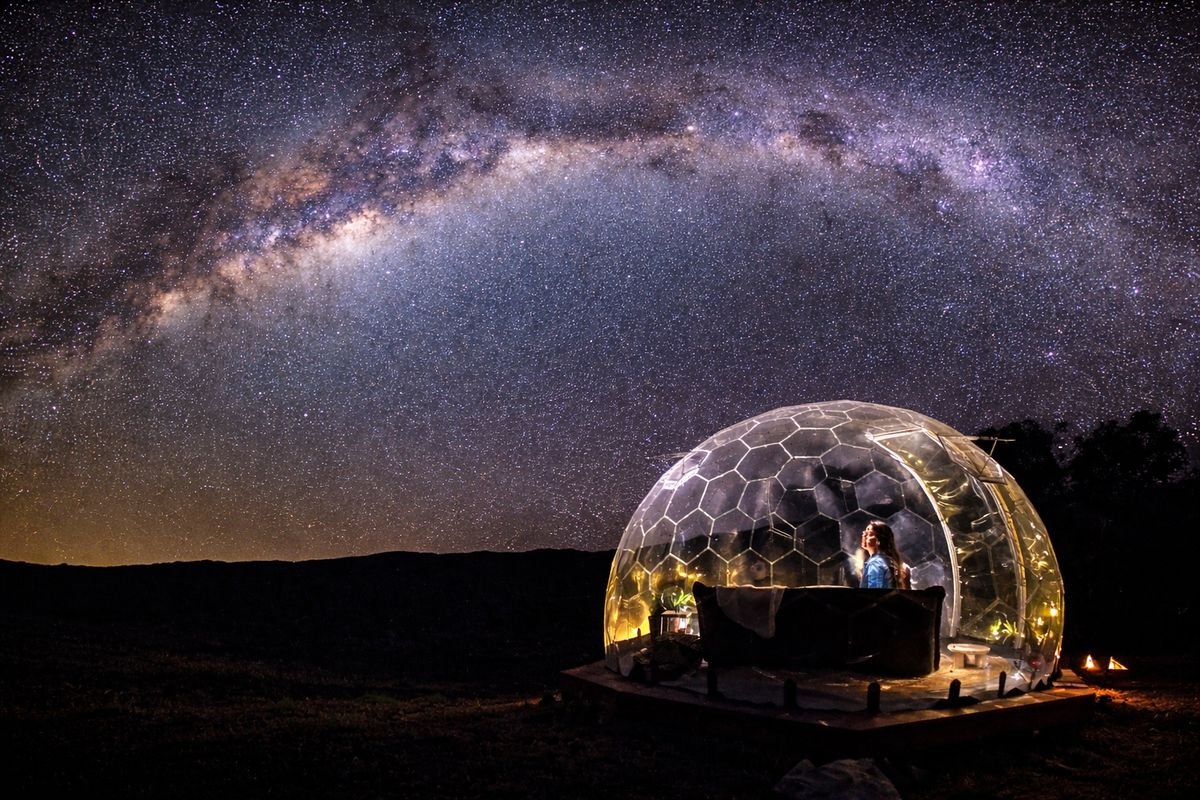
If you’ve spent any time camping in a traditional tent, you know the routine. You pitch the nylon, zip up the bug mesh, unroll a sleeping bag, and spend half the night trying to ignore the rock sticking into your lower back. If you want to look at the night sky, you either sit outside in the freezing desert wind or unzip the rainfly and hope a cloud of mosquitoes doesn’t move in.
For a long time, that was just the trade-off. If you wanted uninterrupted views of the cosmos in a truly wild place, you had to rough it.
That is why the sudden explosion of transparent bubble domes across the world’s most remote deserts feels like such a massive shift in how we travel.
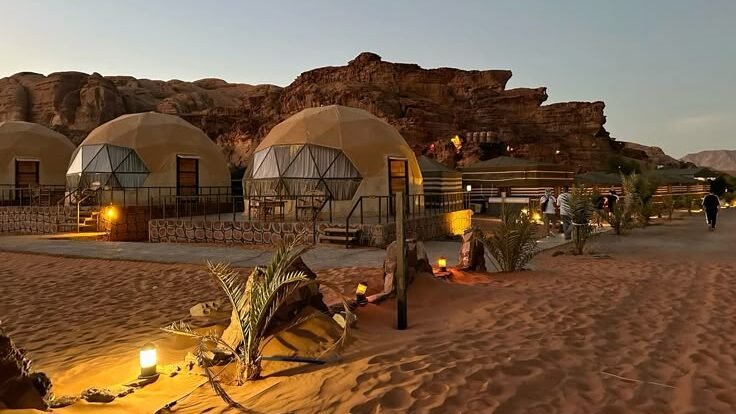
Over the last couple of years, these inflatable, see-through spheres have cropped up everywhere from the red dunes of Wadi Rum in Jordan and the high-altitude deserts of Chile to the red rock canyons of Utah. They promise something that used to be impossible: a total 360-degree view of raw wilderness and dark skies, experienced entirely from a plush, climate-controlled king bed.
The Raw Magic of Clear Walls
The impulse behind this trend is pretty straightforward. People want to feel completely immersed in nature without feeling like they’re surviving a harsh wilderness test.
Traditional luxury desert lodges usually rely on thick stone or concrete walls to keep out the punishing daytime heat. It’s practical, but solid walls completely cut you off from the landscape you traveled thousands of miles to see. Once you step inside your room for the evening, you’re just in a nice hotel room that happens to be in a desert.
Transparent domes completely flip that relationship. Because your walls are made of high-grade, UV-resistant clear polymer, the environment becomes the entire décor.
You can lie in bed and watch a sudden dust storm sweep across distant sand dunes, or fall asleep under the full arch of the Milky Way without feeling a single cold breeze. It creates a strange, wonderful sensation of being simultaneously outdoors and completely sheltered.
Engineering Comfort in Brutal Terrain
Of course, putting what is essentially a giant plastic bubble in the middle of a desert sounds like a recipe for baking yourself alive. Deserts are notoriously unforgiving environments—100-degree heat during the day can easily crash down into near-freezing temperatures by midnight, all accompanied by blowing sand and fierce winds.
Making these structures livable took a bit of clever engineering.
To keep guests from turning into greenhouse vegetables, modern dome resorts tuck high-capacity heat pumps and quiet HVAC systems under raised wooden decks. Continuous air pumps keep fresh air moving through the dome to prevent condensation, while double-walled insulation handles the brutal heat spikes.
For privacy—because sleeping in a fully transparent bubble on a shared property can feel a bit exposed—designers usually curve the bed away from sightlines, build strategic wooden partitions, or install smart glass that switches from clear to frosted at the push of a button.
A Way to Leave No Trace
Beyond how good these places look on social media feeds, there’s an environmental argument for transparent architecture that doesn’t get talked about enough.
Deserts host incredibly fragile biological ecosystems. Building a standard hotel requires digging heavy foundations, laying concrete, and permanently tearing up local soil crusts that can take decades to recover.
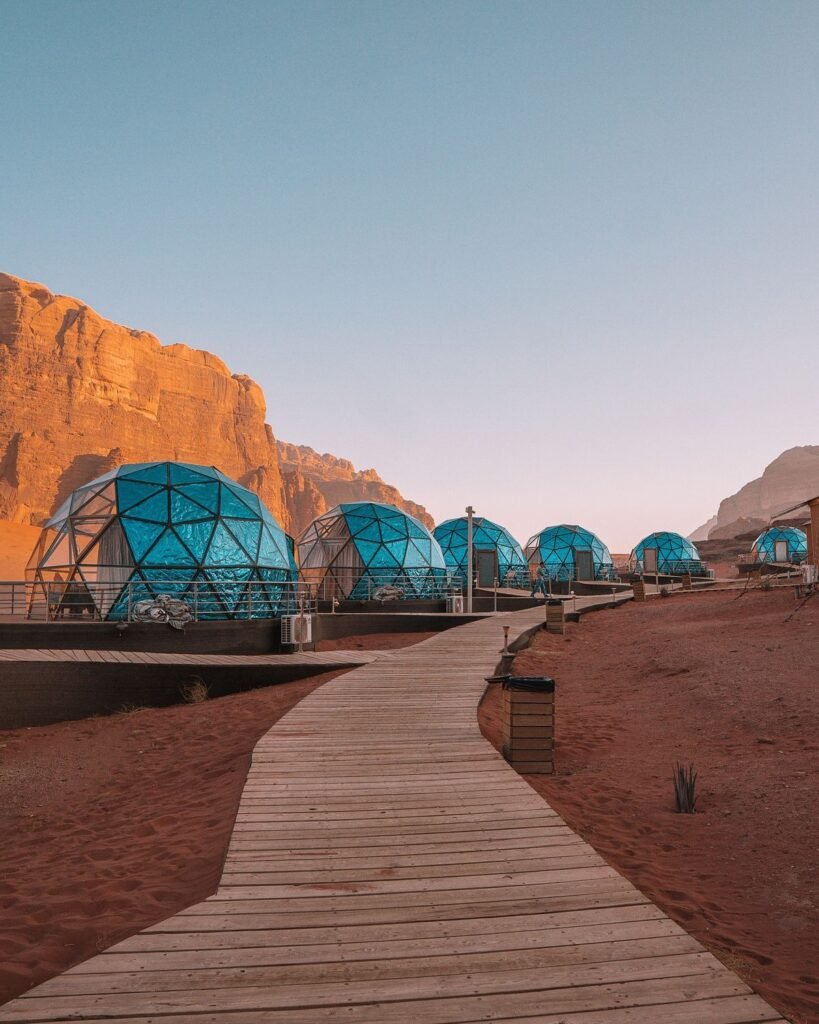
Bubble domes, by comparison, have a surprisingly light footprint. They sit on simple timber platforms raised off the ground, leaving the desert floor beneath them largely untouched. If a resort operator ever decides to pack up and move, the domes can simply be deflated, dismantled, and hauled away, leaving the landscape almost exactly as it was found.
What Remote Travel Looks Like Now
At the end of the day, the rise of desert bubble domes points to a bigger shift in what people want from a vacation. True luxury isn’t really about gilded chandeliers or white-glove bellhops anymore. It’s about access to rare, unforgettable moments in wild places—and being able to enjoy those places without destroying them or shivering through the night.