
There is a plateau in northeastern Turkey, at the edge of a deep river gorge that marks the border with Armenia, where a city of 100,000 people once stood. In the year 1000 AD, Ani was one of the largest cities in the world — the capital of the Bagratid Armenian Kingdom, a metropolis of cathedral spires, merchant caravans, palace complexes, and defensive walls so formidable that travellers arriving from Constantinople reported them as the most impressive fortifications they had ever seen.
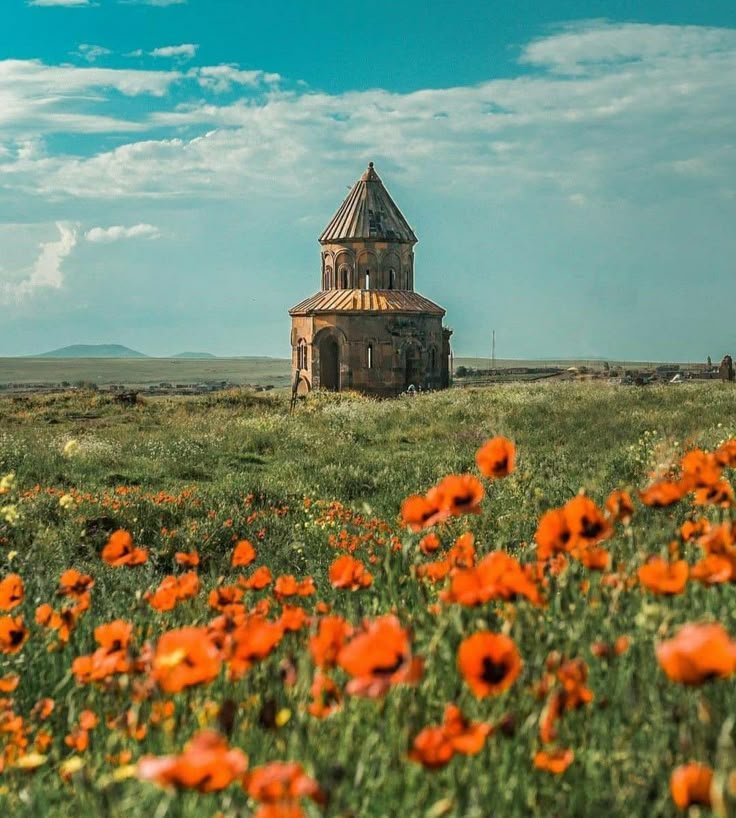
Today, almost nothing stands above waist height. The plateau is grass and wind and the remnants of walls dissolving slowly back into the earth. Storks nest in the ruins of a thousand-year-old cathedral. The gorge below runs green and silent. On the other bank, invisible but present, is Armenia — a country that cannot enter Turkey, and cannot therefore visit the greatest city its medieval civilisation ever produced.
Ani is one of the most haunting places on earth. And almost no one goes there.
A City Written Out of the Map
For most of the 20th century, Ani was a military zone. Situated directly on the Turkish-Soviet border — and after 1991, the Turkish-Armenian border — it was inaccessible to civilians, walled off not by its own medieval fortifications but by the political consequences of one of history’s most contested tragedies. Turkey and Armenia have no diplomatic relations. The border between them has been closed since 1993. A city that once connected the Silk Road’s great commercial routes now sits at one of the most politically sealed frontiers in the world.
Ani was opened to general tourism in 2004. Even now, visitor numbers remain extraordinarily low — a few tens of thousands annually, in a country that receives 50 million tourists each year. The reasons are logistical: the nearest city of any size is Kars, itself not a common destination, reached by a long train journey or a domestic flight from Istanbul or Ankara. From Kars, Ani is 45 kilometres east along a road that passes through flat, open agricultural land offering no particular signal that what waits at the end of it is among the most significant archaeological sites in the world.
What Remains — and What It Means
To walk into Ani through the Lion Gate — the western entrance through walls that once enclosed a capital — is to experience a specific quality of absence that is different from ruins in general. This is not the picturesque decay of a place that gradually lost its importance. Ani was destroyed: by the Mongol invasion of 1236, by earthquakes, by subsequent conquests and abandonments, by centuries of stone removal as the dressed volcanic tufa of its buildings was carried off for construction elsewhere. What remains is not a ruin in the romantic sense. It is a site.
And yet. The Cathedral of Ani — built between 989 and 1001, designed by the Armenian architect Trdat who also repaired the dome of Hagia Sophia in Constantinople — still stands to a height that makes its scale legible. Its blind arcading, its carved stone surfaces, its Armenian inscriptions still readable after a millennium — these speak the architectural vocabulary of a civilisation that was confident, accomplished, and entirely unaware of what was coming.
The Church of the Redeemer stands in half — literally. An earthquake in 1957 split the circular church down its vertical axis, leaving one half standing and the other collapsed into rubble at its base. The result is one of the strangest and most beautiful ruins in the world: a perfect cross-section of a medieval building, open to the sky, its interior decoration visible from outside as though the structure had simply decided to reveal itself.
The Kız Kalesi — a Seljuk palace perched at the very edge of the gorge — hangs over the Akhurian River with a vertical drop that makes approaching it feel, on windy days, like a decision worth reconsidering. From its edge, Armenia is visible. The other bank is no more than 100 metres away. The distance between the two countries, in geopolitical terms, is immeasurable.
The Weight of the Border
No element of Ani is comprehensible without the border. The Akhurian River Gorge that runs along the site’s eastern edge is not merely a geological feature. It is the line along which one of the 20th century’s defining tragedies was drawn and redrawn — the Armenian Genocide of 1915, its denial, the resulting closure of the border in 1993 following the Nagorno-Karabakh conflict, the severed diplomatic relations that have not been restored in the three decades since.
Armenian visitors — and there are some, arriving via Georgia rather than across the closed border — stand at the gorge’s edge and look down at water that separates them from the greatest monument of their medieval history by a distance a strong swimmer could cross in minutes and a geopolitical reality that makes crossing impossible.
The site sits in this tension quietly, offering no commentary. The wind moves through the cathedral’s empty windows. The storks are indifferent. The grass grows.
How to Go
Ani is reached via Kars, in northeastern Turkey’s Kars Province. Turkish Airlines and Pegasus operate domestic flights from Istanbul to Kars Airport. From Kars, the site is 45 kilometres by taxi or rental car — the drive takes under an hour. There is no public transport to the site itself.
The site is open daily from dawn to dusk. Entry requires a ticket purchased at the gate. A licensed guide — available in Kars, bookable in advance — transforms the experience substantially; the inscriptions, architectural details, and historical layers of the site require contextual knowledge that the site’s own signage does not yet fully provide.
Spring and autumn are the finest seasons: mild temperatures, clear light, and the particular quality of northeastern Anatolian landscape at its most open and unhurried. Summer brings heat and the occasional tour group. Winter closes the site intermittently due to snow and ice, but arrives with a silence that the plateau seems to have been waiting for.
Go with time. Go with a guide. Go knowing what you are standing inside — because Ani does not announce itself. It waits for the visitor to arrive at its meaning at their own pace, across grass and wind and a thousand years of complicated quiet.